

The symbolic patron of our order is Emperor Constantine the Great
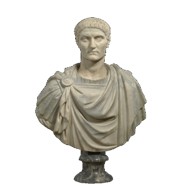 To the four Platonic virtues: fortitude, justice, moderation and prudence, he added two more, kindness and tolerance.
These are reproduced in the Constitution of the Order in our register in English: Fortitude, Justice, Temperance, Prudence, and Constantine's two Kindness and Tolerance.
Constantine the Great was born in the mid-280s in Nis in what is now Serbia. According to consistent information, he was endowed with great mental and physical qualities and has been given the epithet "the Great" for his time as emperor. Another emperor described him as a "subverter and renewer of the entire Roman state".
His father Constantine Chlorus, who was a successful military leader, became caesar or vice-emperor of the Roman Empire in 293. At that time, it had been ruled for some years by a four-man government, tetrarchs, with two in the western part (Augustus-emperor and Caesar-vice-emperor) and two in the eastern part.
Constantine was then sent to the court of Emperor Diocletian in Nicomedia, in present-day western Turkey, as a sort of hostage. There he was trained in the harsh school of war and gained a reputation as a brave, bold and very capable warrior.
In 305, Emperor Diocletian unexpectedly withdrew and his Caesar Galerius became Emperor Augustus in the eastern part of the empire and Constantine Chlorus in the western.
Constantine's position became more difficult because Galerius suspected both Constantine and his father. However, he managed to travel to his father who was on a campaign in Britain.
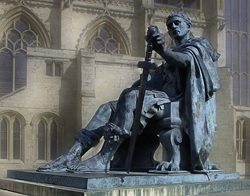
After his father's sudden death in 306 in York, the army proclaimed him, in Roman fashion, Supreme Emperor Augustus for the western half. But Galerius reluctantly recognized him only as Caesar-Vice Emperor. Constantine's empire at that time only included Gaul (France) with Spain and Britain.
After the death of Galerius in 311, the empire was divided between 4 emperors. Licinius, Maximinus Daza in Asia and Egypt, Maxentius in Rome and Italy and Constantine in the West.
The system of four leaders, tetrarchs, naturally proved to lead to conflicts. Constantine was well equipped for this power struggle and when war broke out between him and Maxentius, Constantine led this with great skill to victory at the Milvian Bridge, outside Rome in 312.
It was the evening before the battle that Constantine saw in the sky above the setting sun a radiant cross with a Greek inscription that can be translated "In this sign you shall conquer" and that night in a dream he had received the command of Christ to use the sign of the cross.
It is historically clear that he then used the sign on his banner and, according to reports, had it engraved on the shields of his warriors, especially as it seemed to be a sign of victory and which his army therefore gladly celebrated.
The following year he passed an edict in favor of Christianity; the edict decreed complete religious freedom and at the same time recognized the Christian congregations and gave them rights to property and that they would recover what they had lost during previous persecutions.
A couple of years later, in 314, battles broke out between Licinius and Constantine in which Constantine, with skill and luck, won new victories.
In honor of Constantine's victories over Maxentius and Licinius, the Roman Senate had a triumphal arch built, which can still be seen in Rome today.
After a peace treaty, the battles resumed a decade later between Constantine and Licinius with Constantine as the final victor and thus sole emperor. He then ruled alone and undisturbed until his death in 337.
After his victory in 323, he declared in an edict to the people of the Eastern Roman Empire that the God of the Christians was the only true God. Paganism was then only tolerated and the emperor showed, in many ways, including through his participation in the first ecumenical council in Nicaea in 325, his interest in the Christian church at the same time as he sought to assert secular power through the church.
Constantine continued Diocletian's system of administration. The Roman Empire was divided into four prefectures: the East, Illyria (Greece, Macedonia, Moesia), Italy (with the Danube countries and Africa) and Gaul (with Spain and Britain). The prefects had only civil authority. Command in war belonged to two "magistrati". The troops were divided into two classes: internal troops and border troops.
A measure of great importance was the founding of Constantinople. Like several of his predecessors, Constantine had no fondness for Rome and, like them, he had spent long periods in field camps. During his war with Licinius, Constantine was impressed by Byzantium's location at the easternmost tip of Europe, with Asia across the narrow Bosporus. After his victory, he wanted to build a city as a monument to his military success, like other commanders since the time of Alexander the Great. At first, he considered rebuilding Troy, but he preferred Byzantium, which was easily defended and surrounded by water on three sides, and which lay almost exactly between the eastern and western fronts. A natural crossroads for the entire empire.
 According to tradition, Constantine himself laid out the city, which by the standards of the time became enormous: many times larger than the old Byzantium and protected on the land side by a powerful wall. From 324 until the inauguration on Monday, May 11, 330, nothing was spared to make the city beautiful. Many ancient sculptures and treasures were taken from all over the empire to beautify the city. Constantine himself laid the foundation stones for many buildings such as the Hagia Sophia Cathedral, the palace, the hippodrome, etc.
Constantine was also particularly interested in the construction of Christian monuments in Jerusalem, such as the five-aisled basilica built over the newly discovered tomb of Jesus. During a pilgrimage to Jerusalem, his mother Helena found the cross of Jesus, which was taken to Constantinople.
In his last years, Constantine was struck by personal tragedies. He had his eldest son executed for allegedly seducing Constantine's second wife, but when his mother Helena said that this was not true, he had his wife scalded to death.
In 337, Constantine began a campaign against the Persians because they had attacked Arab tribes allied with Rome. On the way, he suddenly fell ill and tried to return to Constantinople but only reached Nicomedia, where he was baptized on his deathbed by Bishop Eusebius. Being baptized on his deathbed was not unusual at that time. In this way, one had no opportunity to commit any sin after baptism.
However one judges Constantine, he is well worthy of his nickname "the Great".
Not least because he understood what the times demanded of him and through his efforts gave the doomed Roman Empire a strength and status that meant that it survived him for more than a thousand years through what we call the Byzantine Empire.
Few empires have existed for so long.